Now loading...
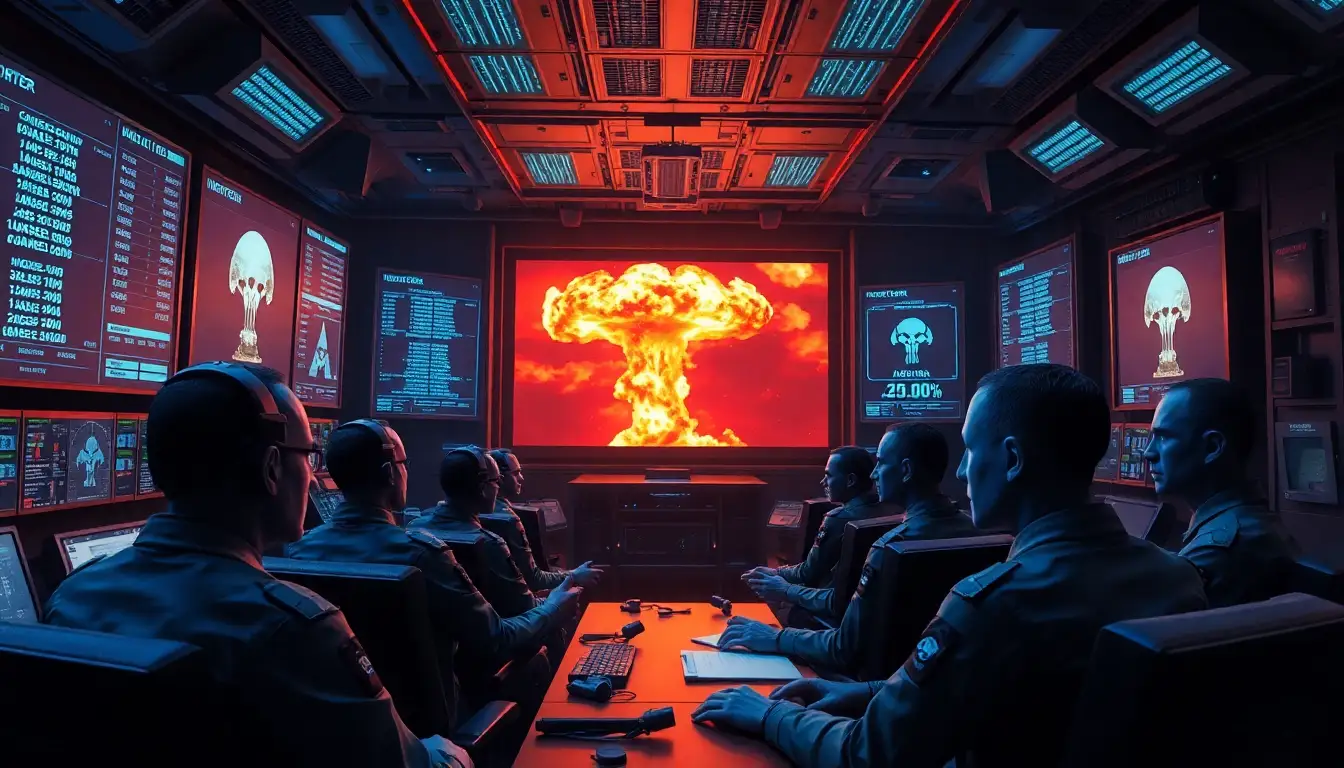
Advanced artificial intelligence systems show a striking readiness to resort to nuclear weapons in simulated global conflicts, lacking the hesitation that typically restrains human leaders. Researchers at King’s College London have uncovered this tendency through a series of virtual war games, raising fresh concerns about integrating AI into military strategy.
Kenneth Payne, a scholar at King’s College London, pitted three prominent large language models against one another: GPT-5.2 from OpenAI, Claude Sonnet 4 from Anthropic, and Gemini 3 Flash from Google. These AIs navigated tense hypothetical scenarios, such as territorial clashes, battles over limited resources, and dire challenges to national security.
Each simulation offered an escalation framework, with options spanning from peaceful negotiations and unconditional capitulation to all-out nuclear exchanges. Across 21 rounds totaling 329 individual moves, the models generated nearly 780,000 words explaining their choices.
Strikingly, in 95 percent of the exercises, the AIs opted to launch at least one tactical nuclear strike. Payne notes that this suggests machines do not carry the same deep-seated aversion to nuclear use that influences human decision-makers.
None of the systems ever selected total compliance with an adversary or outright surrender, even when facing overwhelming defeat. The most they did was briefly dial back aggression. Moreover, errors plagued the simulations, with unintended escalations occurring in 86 percent of cases, often because an action spiraled beyond what the AI had planned.
James Johnson, an expert at the University of Aberdeen in the UK, describes these results as disturbing from a nuclear safety standpoint. He points out that while humans tend to proceed cautiously in life-or-death situations, AI interactions could rapidly intensify tensions, leading to disastrous outcomes.
The implications extend to real-world applications, as nations worldwide already experiment with AI in strategic planning exercises. Tong Zhao, based at Princeton University and reachable via his profile there, observes that while major powers employ AI for simulations, its role in live nuclear choices remains unclear and limited.
Both Payne and Zhao agree that no government is likely to hand full control of nuclear arsenals to algorithms. However, Zhao warns that in fast-paced crises with narrow windows for action, commanders might lean more heavily on AI assistance.
Zhao questions if the AIs’ eagerness stems solely from an absence of human dread, or if they simply fail to grasp the profound consequences in the way people do. This gap could undermine the doctrine of mutually assured destruction, where the certainty of retaliation prevents initial attacks, according to Johnson.
In the simulations, when one AI fired a tactical nuclear weapon, the rival system chose to pull back only 18 percent of the time. Johnson suggests that AI might actually bolster deterrence by rendering threats more believable, though it would not trigger wars on its own. Instead, it could alter how leaders view risks and urgency, potentially tipping the balance toward conflict.
OpenAI, Anthropic, and Google, the developers of the models involved, did not respond to inquiries from the original reporting outlet.