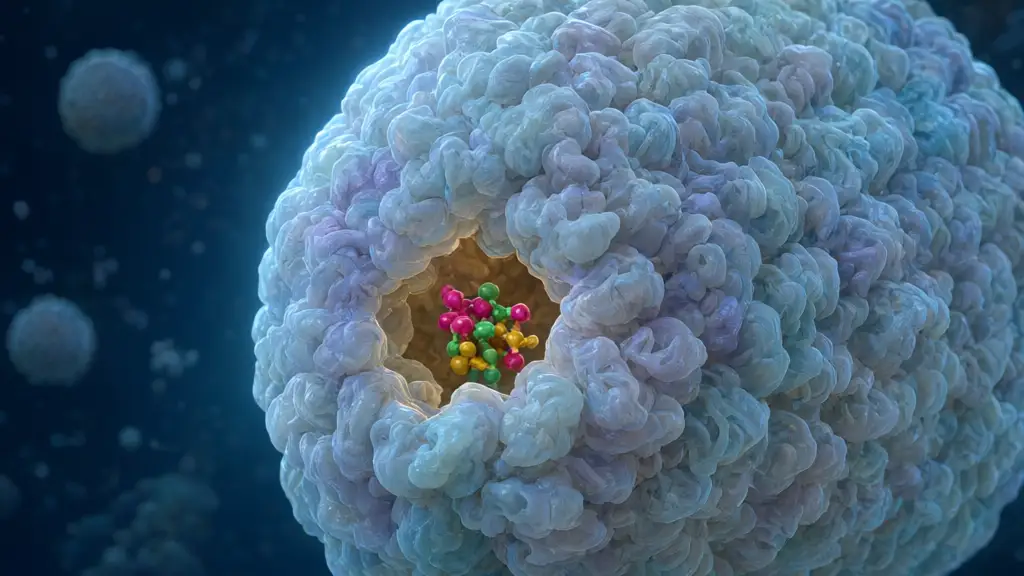
Anthropic says its biology team has mapped the first three-dimensional structure of a vault-like particle found in prokaryotes, the broad group that includes bacteria and archaea. The finding expands the known range of vaults, large hollow protein assemblies whose purpose remains a puzzle, and offers researchers a simpler system for studying how they evolved.
The structure came from a protein associated with a bacteriophage, a virus that infects bacteria. It is made of 96 copies of one protein, compared with 78 copies in the mammalian vault. Using cryo-electron microscopy, the team found that the particle is about 54 nanometers long and 45 nanometers wide. Though shorter than its mammalian counterpart, its rounder shape gives it roughly 25 percent more enclosed volume.
Now loading...
Vaults were first identified in 1986, but decades of research have yet to establish what they do. Scientists have suggested roles in moving molecules around cells, protecting against toxic substances, and supporting immune defenses. None has been confirmed, and mice engineered without vault components can develop normally. The structures’ broad distribution across eukaryotes, from slime molds to humans, nevertheless hints that they may offer some evolutionary advantage.
Anthropic researchers searched a database of about 15 billion predicted proteins for distant relatives of the vault protein. They found these sequences in 29 bacterial groups and four groups of archaea, although they appeared in fewer than one percent of species with sequenced genomes. The team tested 44 candidates, then produced the strongest performers in E. coli. Seven of 15 proteins tested in living bacteria formed vault-like particles; cryo-electron microscopy confirmed the characteristic shape in four.
The researchers also altered the protein to probe how the shells assemble. Some small changes near the particle’s end caps stopped the structure from closing, leaving open, flower-like shapes instead. In another experiment, they added two repeating segments to the protein, bringing it to nine, the same number found in human vaults. The resulting particles were larger and enclosed about 20 percent more volume, suggesting that vaults could have changed size through duplication of parts of their protein structure.
AI played a role throughout the project, according to Anthropic. The team used Claude to search protein databases, design DNA constructs, improve particle isolation, and process microscopy data. A purification process that the researchers say typically takes about three days was reduced to roughly 90 minutes. Claude helped produce an initial structural model in 34 hours, although the final maps took about a week to complete.
The team also encountered mistakes. One protocol Claude generated included an additive that interfered with introducing DNA into cells, costing the project two weeks. During image processing, the system skipped a standard step and produced a faulty map that mixed the structure with its mirror image. The researchers say they used these missteps to inform the model’s development, while emphasizing that scientists still had to guide the work and assess its results.
A small molecule visible in a pocket on each protein copy remains unidentified. Claude noted that its shape resembles coenzyme A, a molecule cells use to transfer chemical groups, but the researchers have not established what it is. The team has also yet to show that the particles form naturally in the bacteria or phages from which their proteins originate.
The findings do not solve the vault’s biological mystery. Instead, they establish that vault-like particles occur across a wider range of life than previously demonstrated and provide a new structure for further investigation. Anthropic has shared its results in a technical report, which it says has been submitted to bioRxiv.