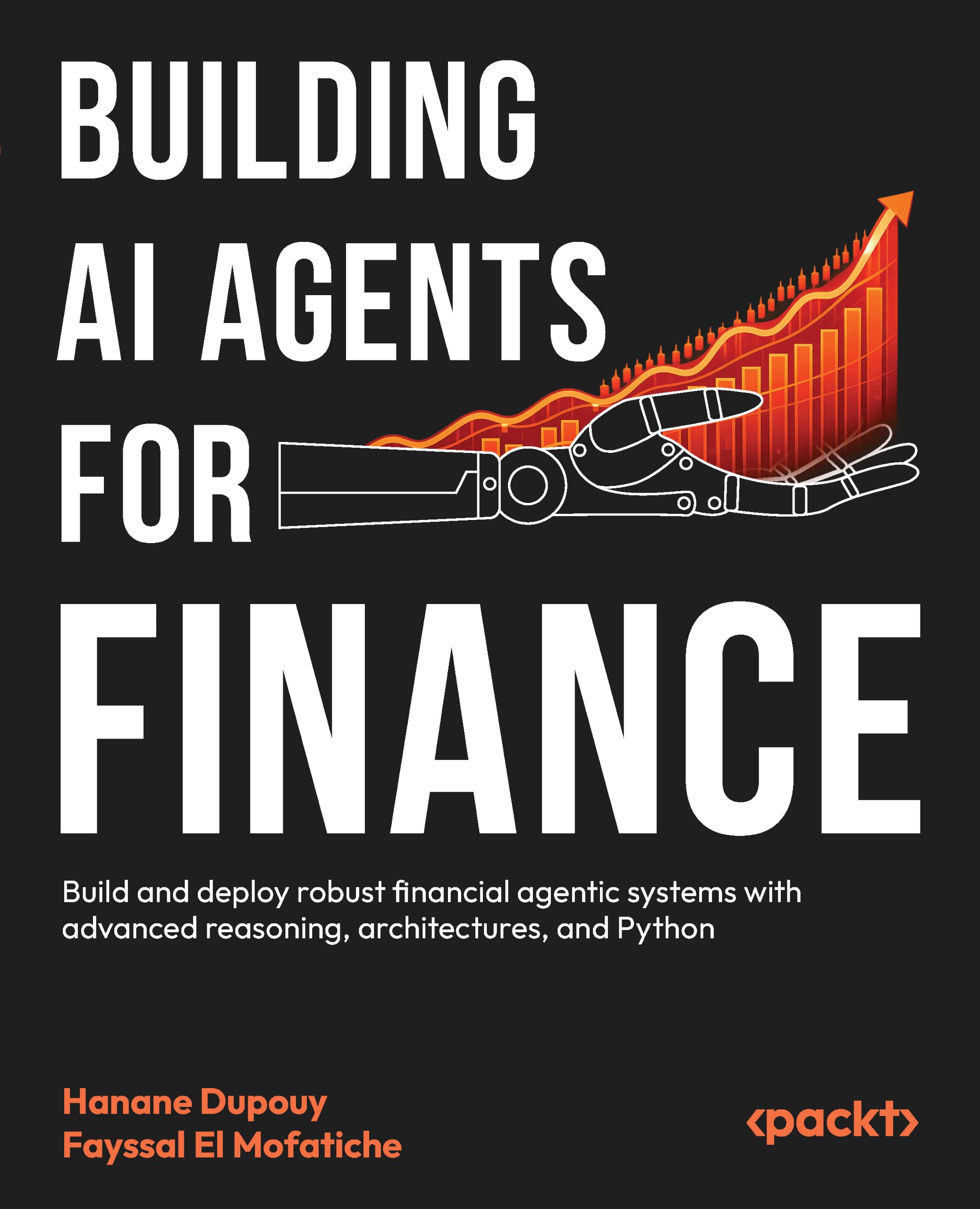
Building AI Agents for Finance aims at a timely, demanding intersection: practical AI agents, sound financial reasoning, and Python-based implementation. Its focus on building and deploying robust systems makes it especially appealing to readers who want to move beyond experimenting with chatbots and start thinking about how autonomous tools might fit into real financial workflows.
The promise here is breadth with a practical destination. Financial agents need more than fluent answers: they must handle complex tasks, work within clear limits, and produce results that can be checked. A book centered on reasoning, architectures, and deployment should be most useful when it helps readers connect those concerns rather than treating them as separate topics. That makes this a potentially strong fit for developers and finance professionals who are ready to explore how agentic systems could support research, analysis, or portfolio-related work.
It is worth approaching the subject with healthy skepticism, though. In finance, a convincing response is not necessarily a correct one, and an automated workflow can magnify mistakes as easily as it can save time. Readers should look for guidance they can apply to validation, oversight, and risk management—not just ways to make an agent perform more steps. The most valuable lessons are likely to be the ones that help you decide when an agent should act, when it should ask for human input, and how to tell whether its output is dependable.
The book is best suited to readers who already have some comfort with Python and want to apply it to financial problems. It may also serve finance practitioners who are technically curious and willing to build their programming skills along the way. If you are entirely new to both coding and finance, the combination of subjects may feel like a steep climb; starting with basic Python and core financial concepts would make the material easier to use.
- Consider it if you build financial software, explore AI-assisted analysis, or want a structured route into agent-based systems.
- Keep your expectations practical if you hope to deploy anything in a regulated or investment setting: treat the ideas as a foundation for careful testing, not a substitute for expert judgment.
- It may not be the right starting point if you are looking for a gentle introduction to programming, a general survey of AI, or ready-made investment advice.
Overall, this looks like a purposeful choice for technically minded readers who want to investigate what financial AI agents can do—and, just as importantly, what responsible deployment demands. Its charm will depend on how much practical implementation and safeguards accompany the architectural ideas, but the subject is relevant for anyone building at the boundary of finance and applied AI.