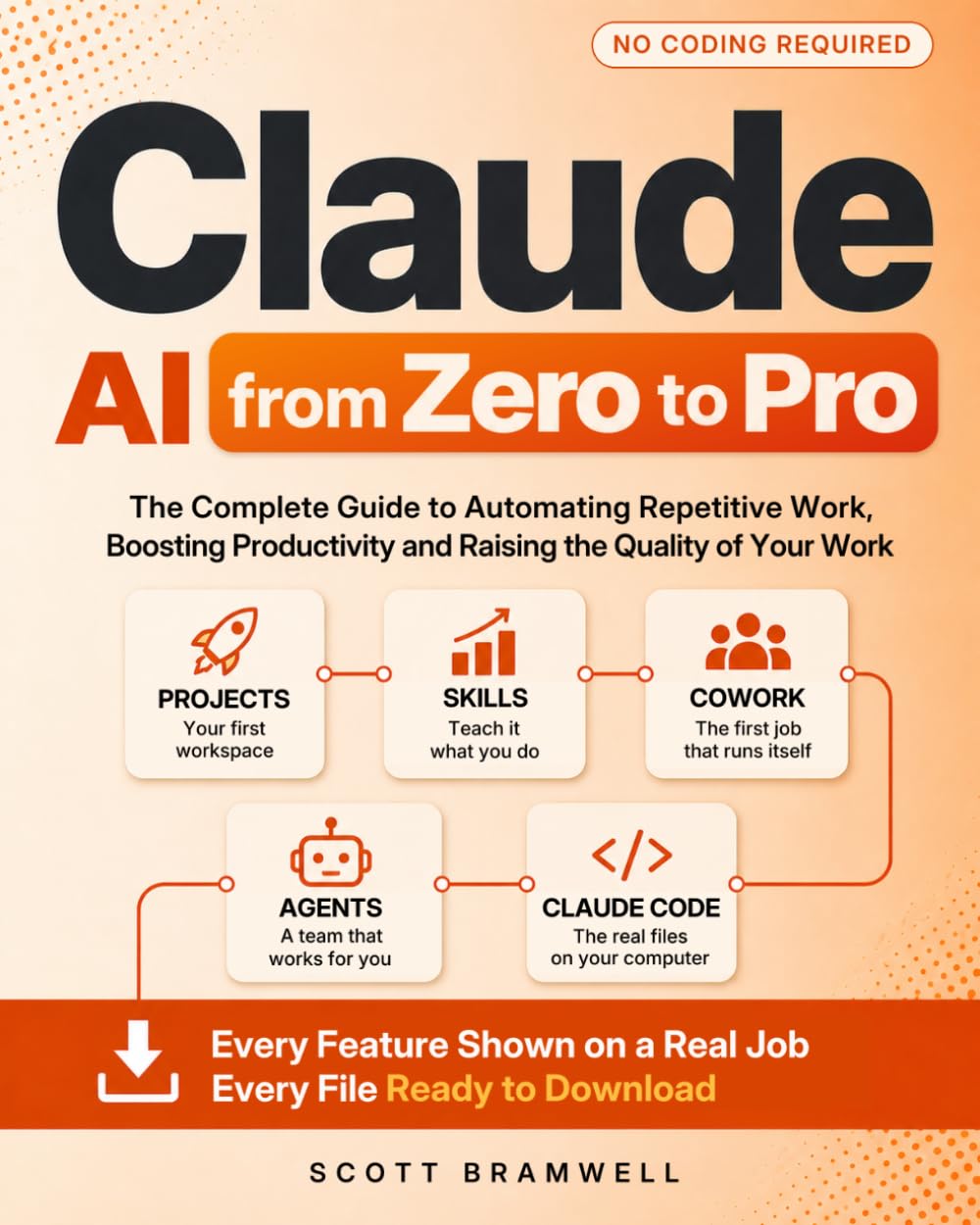
Claude AI from Zero to Pro is aimed at people who want to make Claude useful in their everyday work, not just experiment with it for a few minutes. Its central promise is practical: help readers automate repetitive tasks, work more efficiently, and improve the quality of what they produce, all without needing to code. That makes it especially appealing to busy professionals who are curious about AI but don’t want to begin with a technical manual.
The emphasis on “real jobs” and downloadable files suggests a hands-on approach rather than a book built entirely around explanations. Ready-to-use materials can make it easier to follow along and adapt examples to your own routine. That matters because the hardest part of adopting a new tool is often turning a general idea into a repeatable workflow. If the examples are close to your actual work, this format could help bridge that gap.
This book may be a good fit for people who regularly draft, revise, summarize, organize, or process information. Office workers, freelancers, small-business owners, students, and team leads may all find the no-code focus reassuring. It also sounds suitable for newcomers who want a guided starting point, as well as existing Claude users looking for more structured ways to apply the tool.
To get the most from a guide like this, bring a few real tasks to the page. Note which parts of your week feel repetitive, then try the suggested workflows on low-risk work first. Compare Claude’s output with your own standards, adjust the instructions, and keep only the approaches that genuinely save time or improve the result. Downloadable files are most useful when treated as starting points, not templates to use blindly.
It’s worth keeping realistic expectations, too. “Without coding” lowers the barrier to entry, but it doesn’t mean every process can be automated perfectly or safely. AI-generated work still needs human review, especially when accuracy, confidential information, or a client-facing result is involved. Readers should also expect to adapt examples to their own tools, policies, and working style.
Based on its stated focus, this looks like a practical choice for readers who want a clear route from trying Claude to using it more deliberately at work. It is less obviously suited to people seeking a deep technical account of AI or advanced programming instruction. For anyone hoping to reclaim time from routine tasks while maintaining responsibility for the final work, the combination of no-code guidance and ready-to-use resources is the most promising part of the proposition.