Now loading...
Engineers at NASA’s Jet Propulsion Laboratory have turned to artificial intelligence for the first time to guide the Perseverance rover across the rocky terrain of Mars, marking a milestone in robotic space exploration.
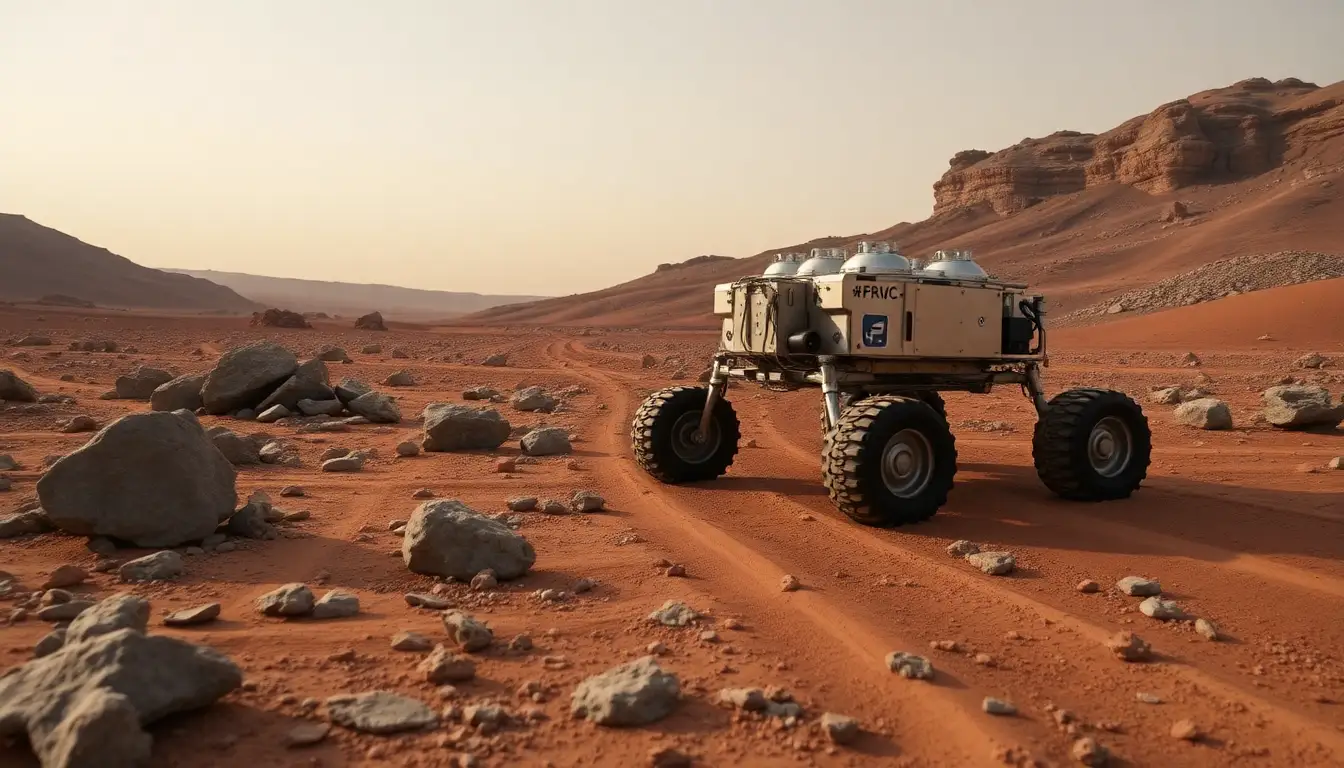
On Dec. 8 and 10, 2025, which correspond to Martian sols 1707 and 1709, commands generated by Anthropic’s Claude AI model directed the rover along a roughly 400-meter route through a boulder-strewn area. The distance is equivalent to a single lap around a standard running track, but it represents an initial step in using AI to assist with planetary navigation.
Communication delays between Earth and Mars, which can take up to 20 minutes for signals to travel one way, prevent real-time control of the rover. Operators typically plot detailed paths in advance using orbital imagery and onboard camera feeds, creating a series of waypoints known as a breadcrumb trail. For this drive, Claude analyzed overhead images and produced the waypoint sequence in Rover Markup Language, an XML-based system developed for earlier Mars missions.
The AI’s planning process involved breaking the route into 10-meter segments, refining them iteratively by evaluating potential issues, and ensuring safe passage. Engineers provided Claude with extensive data from years of rover operations through the Claude Code interface to enable accurate coding. Before transmission via NASA’s Deep Space Network, the proposed paths underwent rigorous simulation, modeling more than 500,000 variables to verify rover positions and identify hazards.
Review by human experts required only slight modifications, such as adjustments for sand ripples visible in ground-level photos that Claude could not access. The rover successfully followed the AI-assisted path without incident, demonstrating the technology’s reliability.
Perseverance, a six-wheeled vehicle equipped with advanced instruments, has roamed Jezero Crater since its February 2021 landing. The site, a 45-kilometer-wide basin that once held a lake and river delta billions of years ago, offers clues to Mars’ ancient watery past and potential for past microbial life. The rover’s tasks include studying geology and climate, gathering rock and soil samples for future return to Earth, and searching for signs of ancient biology. It has already uncovered intriguing features that could indicate biosignatures.
Navigating Mars’ uneven surface poses significant risks. Past missions, like the Spirit rover in 2009, ended prematurely after getting trapped in soft sand. Perseverance’s onboard AutoNav system aids in avoiding immediate obstacles, but long-term route planning remains labor-intensive and relies on human expertise until now.
JPL officials say the AI approach could halve the time needed for route planning, standardize procedures, and free up operators for additional drives and scientific analysis. This efficiency could accelerate discoveries about the Red Planet and support broader goals, including sample collection for human exploration preparation.
The experiment foreshadows AI’s growing role in space missions. As NASA advances its Artemis program to return astronauts to the Moon and build a base at the lunar south pole, versatile AI tools could handle tasks from geological mapping to life-support monitoring, optimizing limited resources.
Looking further ahead, autonomous systems like Claude could enable probes to venture deeper into the solar system, tackling extreme distances where signal delays span hours and harsh environments shorten mission lifespans. Such technology might one day allow robotic explorers to navigate subsurface oceans on distant moons like Europa or Titan independently.