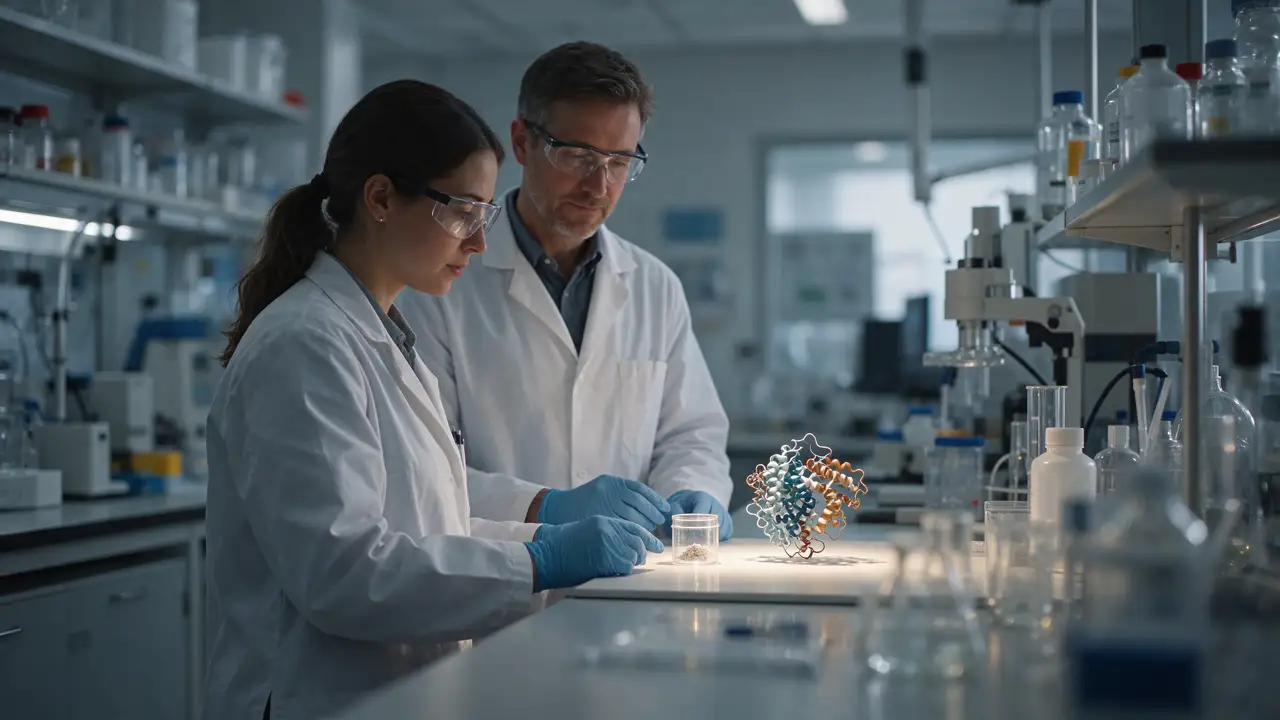
OpenAI says its GPT-6 models can devise protein shapes and amino acid sequences through general reasoning and coding, without relying on specialized biology models to create the designs. The company’s findings, described in a preprint, suggest general-purpose AI could take on some tasks usually handled by purpose-built protein software.
In laboratory experiments conducted with research partner Onava, proteins based on GPT-6.2 designs showed signs of binding to five selected targets. The work also found that redesigned antibody fragments often retained the ability to bind their original targets.
Now loading...
The results do not show that the models can independently produce a fully tested protein. Specialized tools helped researchers generate amino acid sequences for some designs and choose candidates for laboratory testing. The company said its experiments offer early evidence of the models’ design abilities, while noting that important steps still depend on other systems.
Proteins are chains of amino acids that fold into three-dimensional shapes. Their structure helps determine their function, from carrying oxygen to defending against infection. Designing a new protein means finding a shape suited to a task and a sequence likely to fold into that shape.
OpenAI researchers reported that the models could respond to instructions about a protein’s intended attachment point and shape. In computer-based evaluations, an internal model followed directions about the number and arrangement of structural features with high accuracy. The researchers also said the models could shift between different tasks by changing the prompt, rather than retraining the system.
Across a range of computational tests, the latest models matched or surpassed specialized programs on many tasks, including some forms of protein design and predictions about molecular interactions. Predicting the complete structure of a protein from its sequence remained a notable weakness.
In one laboratory test, researchers made and tested 322 small proteins designed to attach to five targets. Thirty-five, or 10.9%, showed evidence of binding. The researchers said the share was lower than results in an earlier study of a specialized design system, but noted that reported success rates can depend on how candidates are screened and how binding is defined.
In a separate test, GPT-6.2 proposed new amino acid sequences for existing small protein binders. Of 107 proteins made from the model’s sequences for three designs, 14 showed binding. The model also generated substantially different sequences for the same design, with both versions showing signs of binding in one example.
The researchers tested antibody redesign as well. Of 182 redesigned antibody examples aimed at one target, 128 showed signs of binding. In another test involving fragments based on five therapeutic antibodies, 179 of 272 retained binding to their original targets.
OpenAI cautioned that binding alone does not make a protein useful as a medicine. Further research would need to assess such properties as stability, selectivity, biological activity, safety and effectiveness. The company also said some benchmark results may be affected by information the models encountered during training.
The work is an early step toward a goal of letting researchers describe a desired molecular function in ordinary language and use AI to help develop candidates for testing. OpenAI said future research will aim to address harder targets, assess effects beyond binding and expand design work beyond small proteins and antibody fragments. The company also said it’s evaluating potential misuse risks as the technology develops.